Living Foundries, DARPA's future molecule shop
Updated: Apr 10
Living Foundries is an ongoing synthetic biology project at DARPA, involving participants in academia, which aims to create the framework for an on-demand shop for creating novel molecules. The end-goal is a foundry for on-demand novel molecule creation for applied materials, adhesives, coatings for aircraft, pharmaceuticals, and internal medicine. Its first 'customer' will be the Department of Defense, but the capabilities being brought to reality in this project may make their way into civilian life, as most military technology does.
This is the same agency that led to the development of the modern internet before the concept of an online bulletin board was known. The projects undertaken here often involve innovative ideas that are challenging for many to imagine because they haven't yet materialized, though they are feasible. In essence, DARPA's purpose is to venture into uncharted scientific territories ahead of others.
This Living Foundries initiative, headed by Dr. Renee Wegrzyn, is applying the mechanical design-test-build approach to synthetic biology, paving the way for developments in areas such as living materials and networks of synthetic biological organisms. So far, the project has completed its initial phase by developing the tools and processes necessary for engineering biological systems to mass-produce new molecules.
The second part of the project- "1000 Molecules"- uses a milestone number to arrive at in terms of novel molecules that are in production stages. The count is currently at 551 in 2019.
This is a brief overview of how this program is path-finding in an unexplored region of applied sciences.
Design
A network of participants, DARPA and academic partners, are working to find synthetic pathways for stitching together different enzymes from humans, plant life, animal life, and extremophiles, to create new synthetic biological systems for a purpose.
Test
This is when the designs are tested in a controlled environment. Designs are inserted into a living system known as a "workhorse organism"- which is a synthetic microorganism used in experimentation. The functionality and integration is analyzed using mass spectroscopy and other measurement instruments. This is where teams are learning by trial what good and bad designs are for further refinement and testing.
Build
A framework develops for a building tools for testing and creating new molecules. The term 'tools' in this context refers to means of gene editing and re-engineering biological systems to become modular and deployable for specific purposes. Once these methods are able to produce detectable amounts, then the build process can move to production.
This program's products are going to be used in other DoD/DARPA projects and if or when they successfully integrate, the possibilities may be incredible.
This can lead one to ask where is this all going. Another adjacent DARPA project gives an example of what's possible when these bio-tools are applied in different domains. One project called ReSource aims to outfit special operations and disaster response teams with "phase zero" usable materials constructed by taking discarded or waste materials and breaking them down and re-building at the molecular level to create new materials.
Phase Zero is DoD-language for starting with materials and infrastructure either beyond repair or non-existent. The idea here is to generate food and other materials from "energy-dense waste".
This can include "recalcitrant carbon-rich" materials- those which are typically resistant to organic decay but made of carbon, like plastic. If you follow the thought, and consider the combination of "mechanical, biological, and chemical catalytic approaches" in a "black-box use" scenario- you end up with something peculiar. This is a box of molecular digestion, breaking down materials at the organic level to be rebuilt back up into other, new usable materials including food.
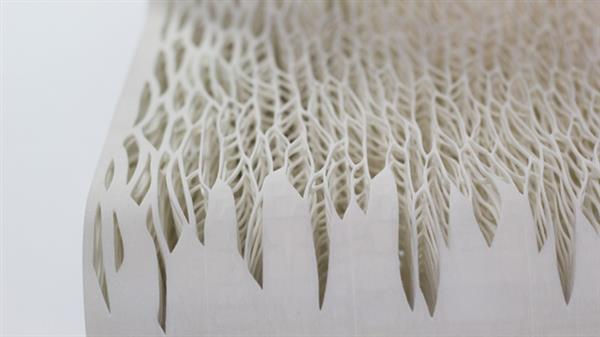
Another example points to one of the most important future technologies I believe will be created from synthetic biology research- Living Materials. These are grown materials that live and react dynamically to their environment. Imagine walls that change, clean and regulate air through synthetic biological systems from nature, removing the need for cooling systems requiring external power.
Comments